Yoga for Beginners: A Complete Guide to Sivananda Yoga
This guide describes yoga for beginners as it is taught in the Sivananda tradition: what the system consists of, what happens in a class, which postures are practised and in what order, and what a new student is and is not expected to do.
Sivananda Yoga is a system of hatha yoga organised around five principles and a fixed sequence of twelve basic postures. Because the sequence does not change from class to class or from centre to centre, it is possible to describe a beginner’s first class in some detail in advance. That is what follows, along with the two breathing practices taught to new students, the structure of the final relaxation, and the background of the system itself.
What yoga means
The word yoga derives from a Sanskrit root meaning to join or to unite. In the Yoga Sutras attributed to Patanjali, the classical text on the subject, the practice is defined in the second aphorism as chitta vritti nirodha — the stilling of the movements of the mind. The definition concerns mental activity rather than physical capability.
This is reflected in how the postures are taught. In a Sivananda class each posture is held for a period and followed by a short rest, rather than linked into continuous movement. The stated purpose of the posture is not the shape itself but the steadiness and the regulated breathing maintained while holding it.
What Sivananda Yoga is
Sivananda Yoga is one of the systems of hatha yoga taught internationally since the middle of the twentieth century. It was set out by Swami Vishnudevananda, a student of Swami Sivananda, and is taught through the Sivananda Yoga Vedanta Centres, whose headquarters were established in Montreal in 1959.
Two features distinguish it from most other systems a beginner will encounter. The first is the five-point framework, which places the postures alongside breathing, relaxation, diet, and meditation as components of equal standing rather than treating asana as the practice in itself. The second is the fixed sequence: the same twelve basic postures in the same order, in every class, at every centre.
The tradition also groups yoga into four paths — karma, bhakti, raja and jnana, corresponding to action, devotion, knowledge and meditation. Swami Sivananda described his approach as the Yoga of Synthesis, meaning the four practised in combination rather than separately. The four paths of yoga are covered separately; the five points are the part a beginner meets first.
Where the system comes from
Two figures account for the form the system takes. The dates below are the published record.
Swami Sivananda (1887–1963)
Born Kuppuswami in Tamil Nadu, he trained in medicine and worked as a physician in British Malaya before returning to India in the early 1920s and settling at Rishikesh. The medical background is visible in what he went on to establish: a charitable dispensary, an Ayurvedic pharmacy, an eye hospital, and a teaching academy. He wrote more than two hundred books.
1887Born in Pattamadai, Tamil Nadu, India.
1923–24Left a medical career in British Malaya, returned to India and settled at Rishikesh.
1927Opened a charitable dispensary at Lakshman Jhula.
1936Founded the Divine Life Society at Rishikesh.
1945Established the Sivananda Ayurvedic Pharmacy.
1948Founded the Yoga-Vedanta Forest Academy.
1957Founded the Sivananda Eye Hospital.
1963Died at Rishikesh, having written over 200 books.
Swami Vishnudevananda (1927–1993)
A student of Swami Sivananda from 1947 and later the first professor of hatha yoga at the Yoga-Vedanta Forest Academy, he was sent to North America in 1957. His 1960 book, The Complete Illustrated Book of Yoga, has sold over a million copies and set out the twelve-posture sequence in the form still taught. In 1969 he held the first yoga teachers’ training course in the West — the model on which most later teacher training programmes, including the 200-hour course taught in Vietnam, are based.
1927Born in Kerala, South India.
1947Arrived at the Rishikesh ashram; later appointed the first professor of hatha yoga at the Yoga-Vedanta Forest Academy.
1957Sent to North America to teach.
1959Established the organisation's headquarters in Montreal, Canada.
1960Published The Complete Illustrated Book of Yoga, which has sold over a million copies.
1969Held the first yoga teachers' training course in the West, in Canada.
1978Published Meditation and Mantras.
1985First teachers' training course in Europe, in Spain.
The twelve-posture sequence has been taught in the same order since it was set out in 1960.
The framework
The Five Points of Yoga
The five components of the system, as set out by Swami Vishnudevananda. Each is treated as part of the practice rather than as preparation for the postures.
1. Proper Exercise — Asana
Postures held for a period rather than repeated as repetitions. The stated aim is the flexibility of the spine and the circulation of blood to the joints, glands and internal organs, rather than muscular development.
2. Proper Breathing — Pranayama
Regulated breathing exercises. In the tradition's own vocabulary these govern prana, meaning vital energy; in practical terms they involve controlling the rate, depth and pattern of the breath.
3. Proper Relaxation — Savasana
Structured rest, practised between postures and for a longer guided period at the end of every class. It is treated as a distinct practice with its own technique, not as a pause.
4. Proper Diet — Sattvic Food
A vegetarian diet of foods classified as sattvic: fresh fruit and vegetables, whole grains, pulses, nuts, and dairy in moderation. Foods are grouped by their described effect on the body and mind.
5. Positive Thinking & Meditation
Concentration and meditation practices, together with the study of the tradition's texts. This is the point under which seated meditation and the observation of thought are taught.
An open class runs about ninety minutes and follows the same order at every Sivananda centre. Beginners’ classes use the same structure with the variations described below.
1
Initial relaxation
The class begins lying down in Savasana. Classes open with a short chant; joining in is optional.
2
Pranayama
Seated breathing practices: Kapalabhati, followed by Anuloma Viloma. These come before the postures rather than after them.
3
Sun Salutations
Surya Namaskar, a linked sequence of twelve movements, repeated several times as a warm-up, usually followed by leg stretches.
4
Leg raises
Single and double leg raises. These build the abdominal strength used in the shoulderstand, plough and headstand.
5
The twelve basic postures
Worked through in the fixed order, each held with regulated breathing and followed by a short rest in Savasana.
6
Final relaxation
A longer guided relaxation, again in Savasana, which closes the class.
Postures are held and adjusted individually, with a rest between each.
The 12 basic postures
The twelve basic asanas, sometimes called the Rishikesh sequence, are practised in a fixed order. The order groups the postures by the area they act on and places each backward bend after the forward bend it balances — the Fish, for example, is the counter-posture to the shoulderstand group and is practised directly after it.
The sequence opens with the headstand, which is not practised in beginners’ classes. New students begin at the shoulderstand.
01
Sirshasana
Headstand
Inverts the body. The first posture in the fixed sequence.
Beginners: Not practised in beginners' classes. Preparatory work is taught instead.
02
Sarvangasana
Shoulderstand
Inverted posture; described as acting on the thyroid gland.
Beginners: Where beginners normally start the sequence. A folded blanket is often placed under the shoulders.
03
Halasana
Plough
Continues the shoulderstand group; stretches the back of the body and the neck.
Beginners: Practised with the knees bent and the feet supported.
04
Matsyasana
Fish
The counter-posture to the shoulderstand group. Arches the neck and spine in the opposite direction and expands the chest.
Beginners: Practised resting on the elbows rather than on the crown of the head.
05
Paschimothanasana
Seated forward bend
Forward stretch of the spine and the back of the legs.
Beginners: Practised with the knees bent.
06
Bhujangasana
Cobra
First of the three backward bends. Extends the upper back.
Beginners: Practised with the elbows bent and a smaller range of movement.
07
Salabhasana
Locust
Second backward bend. Engages the lower back and the legs.
Beginners: Practised one leg at a time.
08
Dhanurasana
Bow
Third backward bend, combining the actions of the previous two.
Beginners: Practised as the half bow, one side at a time.
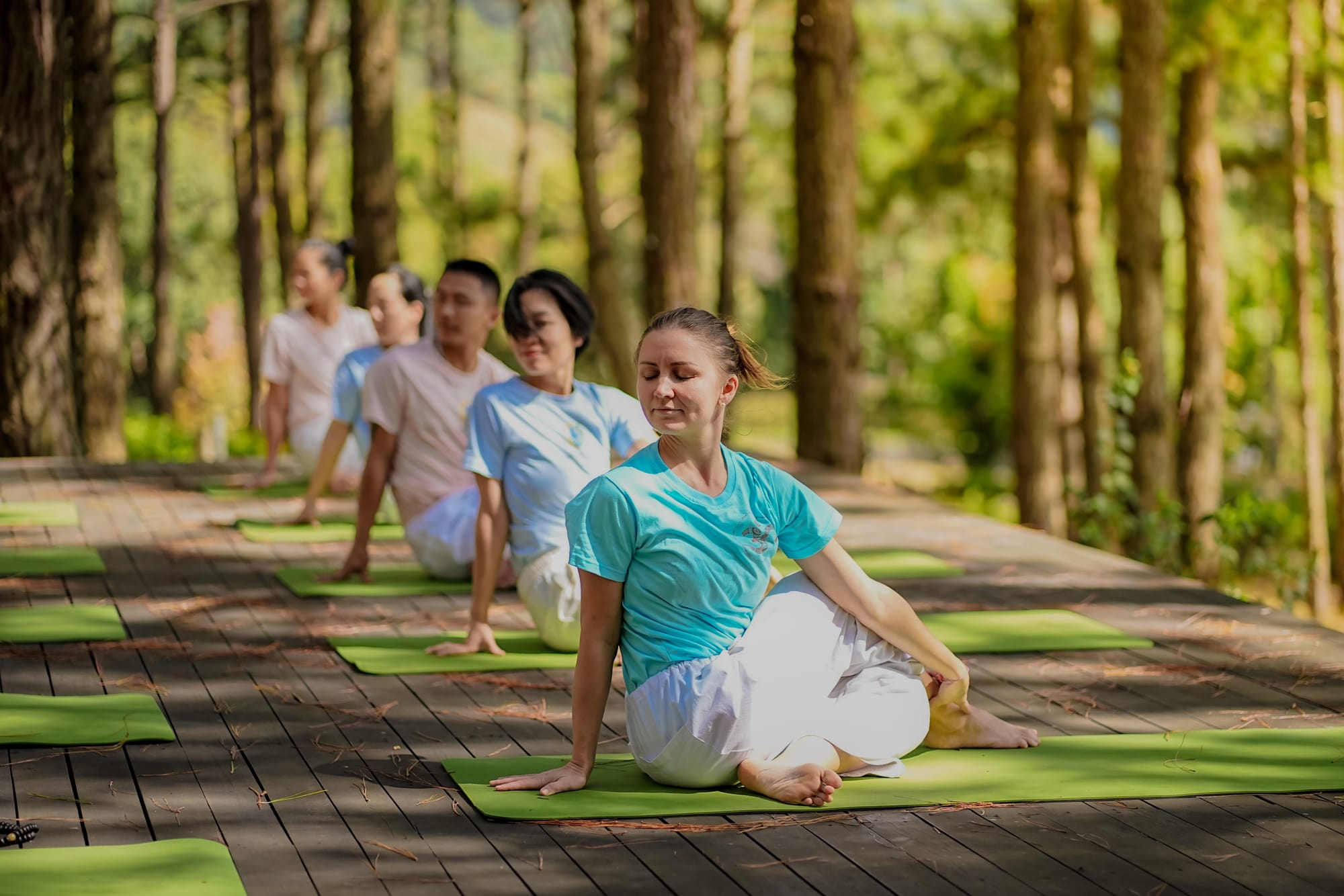
09
Ardha Matsyendrasana
Half spinal twist
Lateral rotation of the spine — the direction of movement the other postures do not cover.
Beginners: Practised seated on a folded blanket so the pelvis stays level.
10
Kakasana / Mayurasana
Crow / Peacock
Balancing posture on the hands.
Beginners: Commonly replaced with Vrikshasana (Tree Pose) or another standing balance in beginners' classes.
11
Padahastasana
Standing forward bend
Standing forward stretch of the spine and the back of the legs.
Beginners: Practised with the knees bent.
12
Trikonasana
Triangle
Final posture. Lateral stretch of the trunk.
Beginners: Practised with the hand resting on the shin rather than the floor.
Every posture in the sequence has variations taught for beginners.
Pranayama for beginners
Pranayama refers to regulated breathing practices. Two are taught to beginners and are practised seated, before the postures.
Kapalabhati
A sequence of short, active exhalations produced by contracting the abdomen, with the inhalation left passive as the abdomen releases. Practised in rounds, with a rest between them. The exhalation is the active phase; the inhalation is not forced.
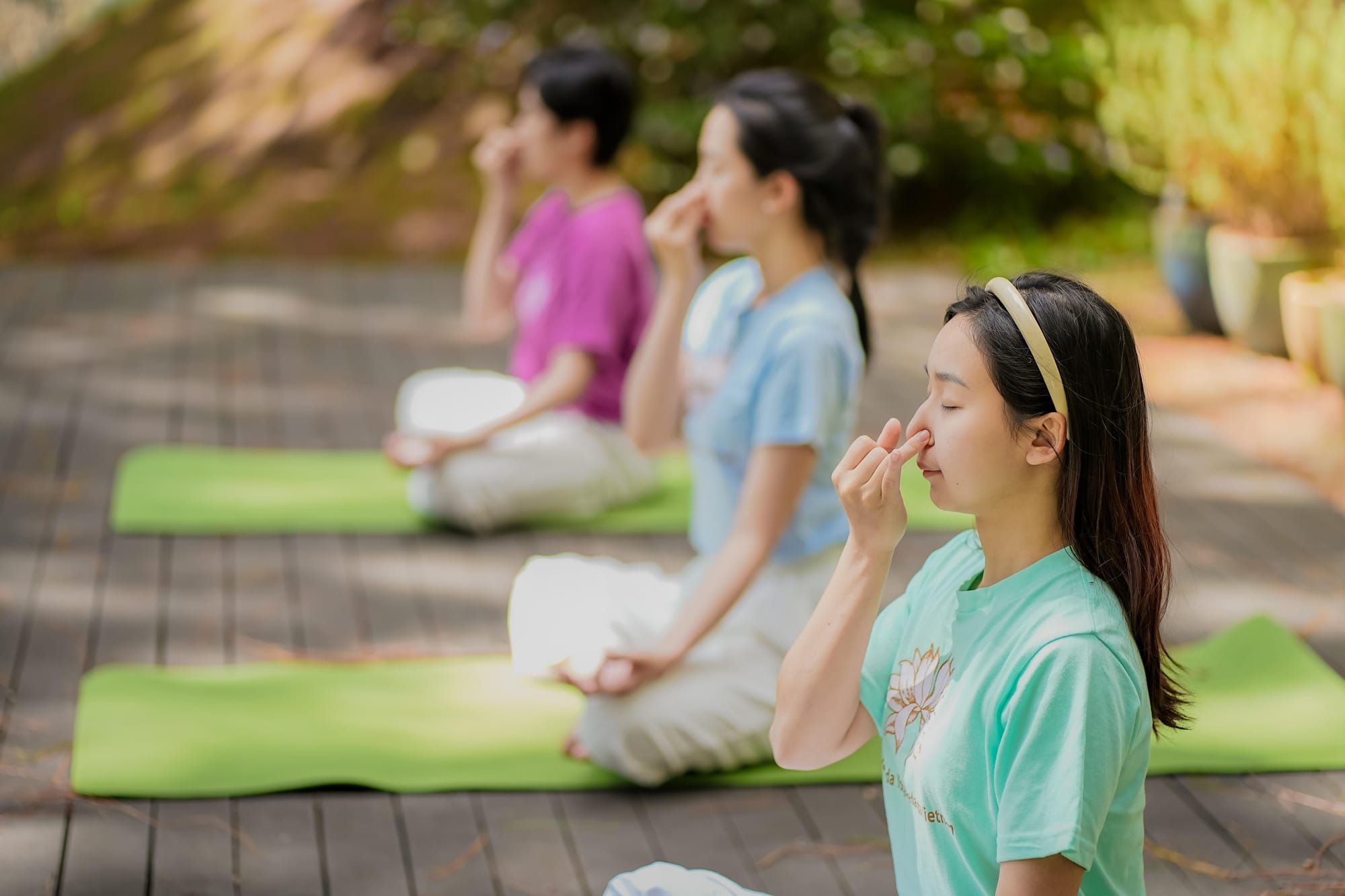
Anuloma Viloma
Alternate nostril breathing. The breath is drawn in through one nostril, retained, and released through the other, then repeated starting from the opposite side; one such cycle is a round. It is taught with a set ratio between inhalation, retention and exhalation, and the number of rounds is increased gradually.
Anuloma Viloma, one of the two pranayama practices taught to beginners.
Proper relaxation
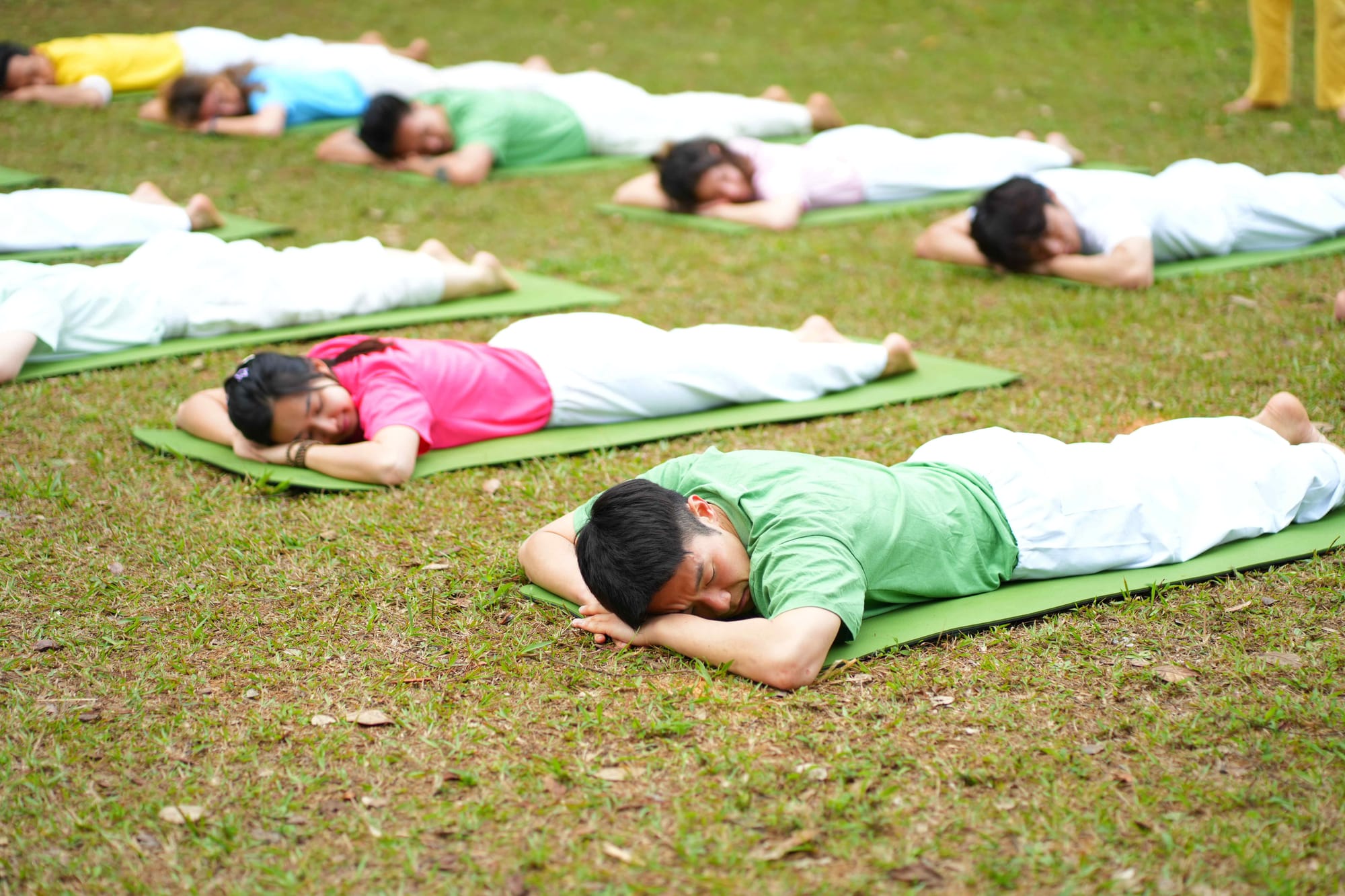
Savasana is practised twice in a class: briefly between postures, and as a longer guided relaxation at the end. The final relaxation is conducted with autosuggestion — attention is directed through the body in sequence, part by part.
The tradition describes relaxation at more than one level: the release of muscular tension, and the slowing of breathing and mental activity that follows it. Both are addressed in the guided sequence. Because body temperature drops during a long relaxation, a blanket or shawl is normally used.
The guided relaxation is part of the class structure, not an optional close.
The yogic diet
The fourth point concerns diet. Foods are grouped into three categories by their described effect: sattvic foods, held to support clarity and steadiness, comprising fresh fruit and vegetables, whole grains, pulses, nuts, seeds and dairy in moderation; rajasic foods, described as stimulating; and tamasic foods, described as heavy or stale.
Meals served at the ashram are vegetarian and prepared on these lines. Attending a class carries no dietary requirement. The practical point that does affect a class is timing: practice is normally scheduled two to three hours after a main meal, because the sequence includes inversions and twists. A yoga vacation is where the diet is followed in full alongside the daily practice.
Sattvic food: fresh fruit and vegetables, whole grains, pulses and dairy in moderation.
Positive thinking and meditation
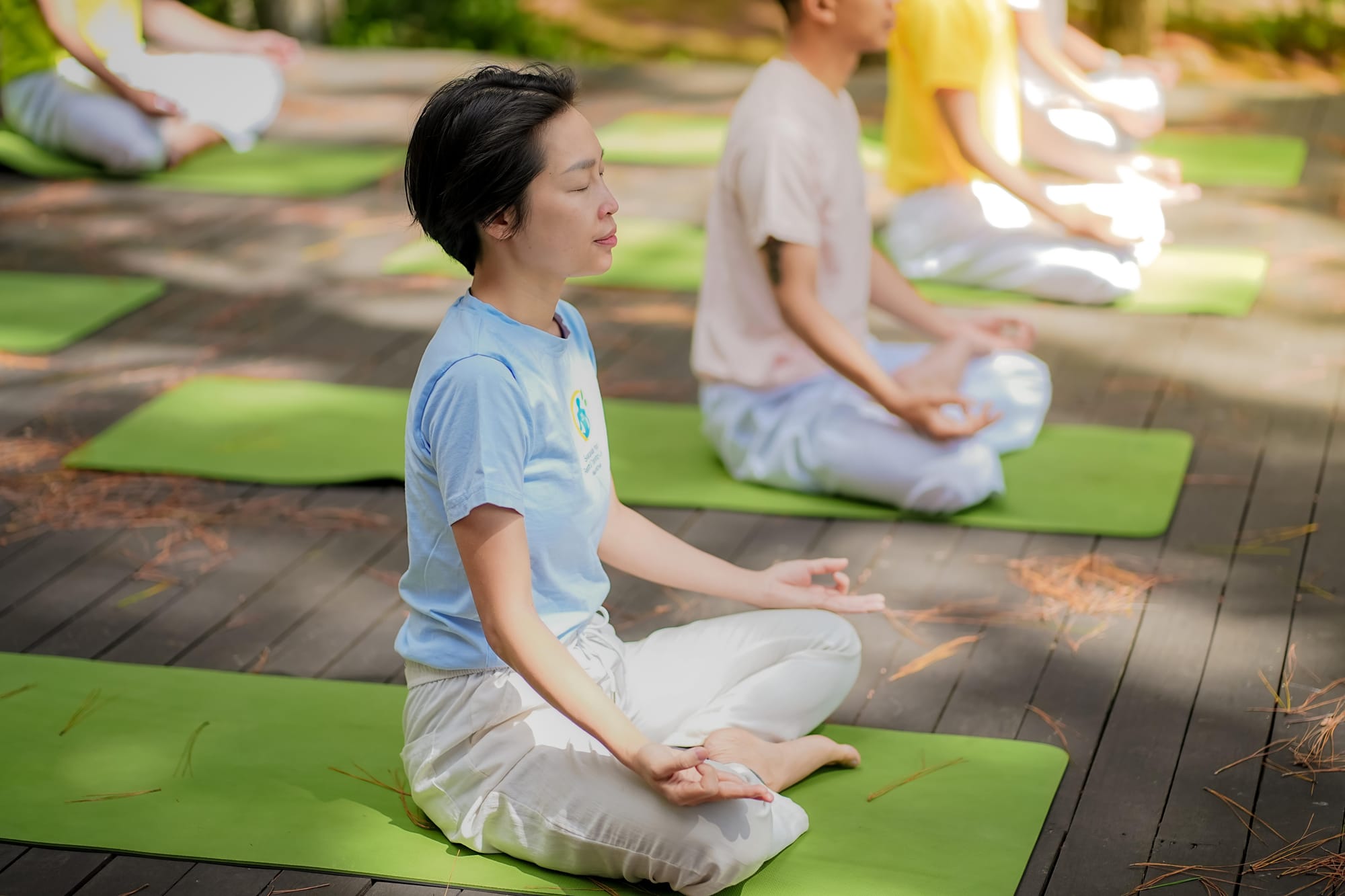
The fifth point covers concentration and meditation. The practice taught is seated: an upright position held at a regular time, with attention directed to a single object — commonly the breath — and returned to it each time it moves elsewhere.
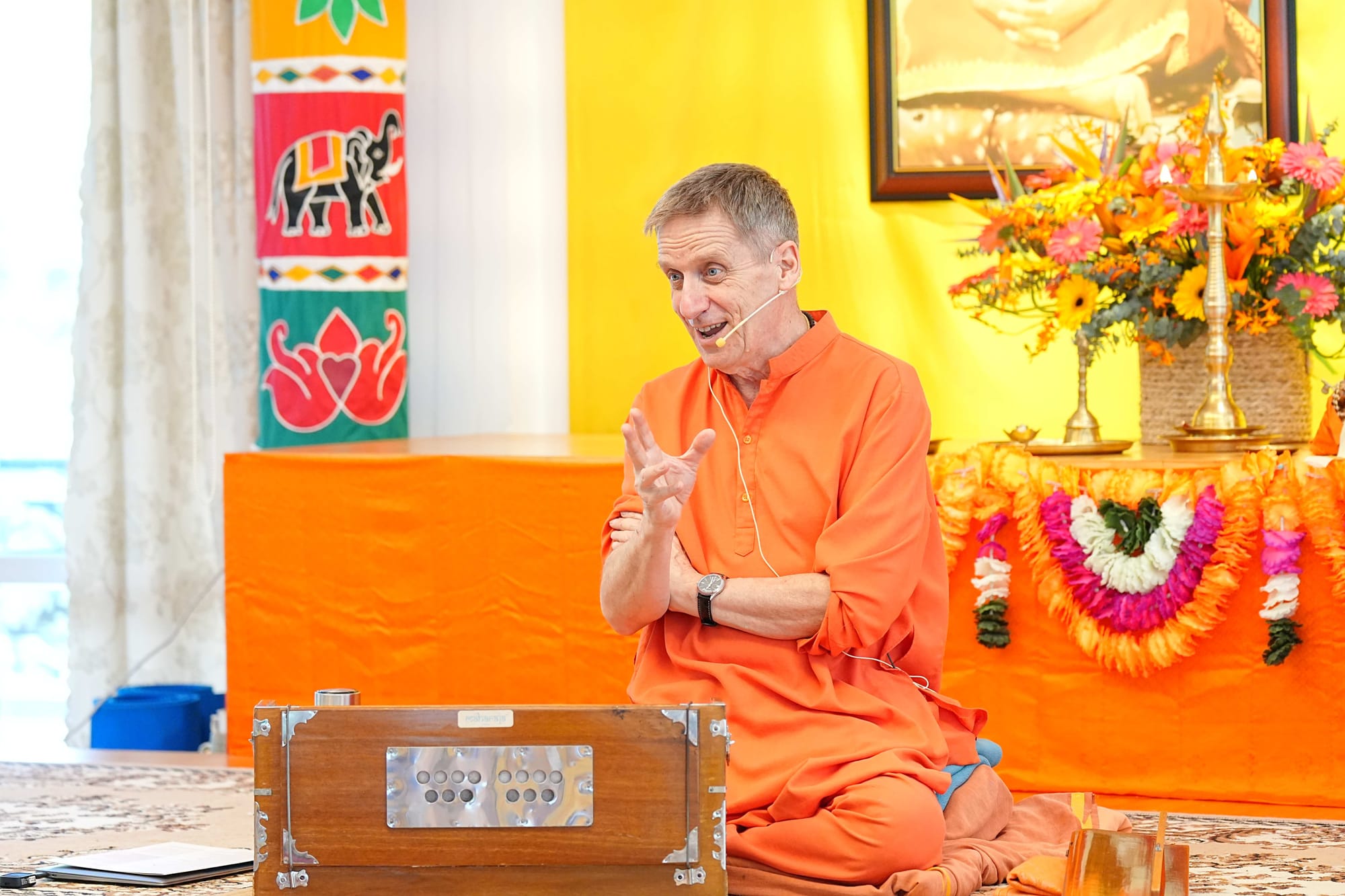
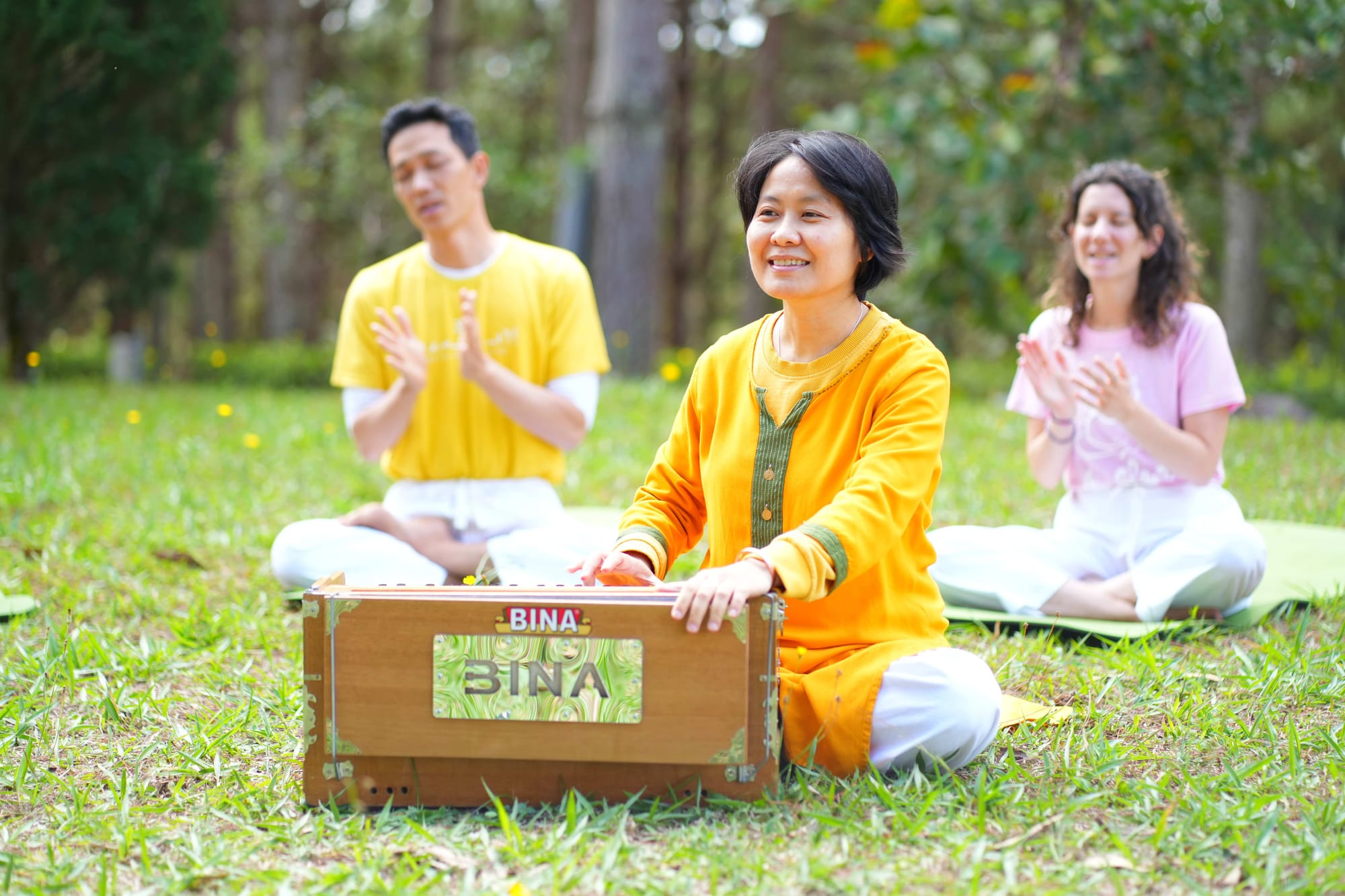
Sessions are normally short at first and lengthened over time. In this tradition the seated practice is often accompanied by the repetition of a syllable or phrase, and centres hold an evening gathering for chanting and study. Attendance and participation are optional. Further background is on the Sivananda teachings page.
The evening gathering for chanting and study; attendance is optional.
The system in numbers
5
Points of Yoga
4
Paths of Yoga
12
Basic postures
90
Minutes per class
How beginners progress
Progression in this system is defined by how long a posture is held and which variation is used, rather than by moving on to a different sequence.
Attending classes
Beginners' and open classes follow the same fixed sequence, so the order becomes familiar without needing to be memorised. Variations are offered for every posture and are the expected form for a new student.
Holding the postures
Postures are held rather than flowed through, with a short rest between each. The published guideline in the tradition is that a basic posture should be held for three minutes before advanced variations are attempted.
Adding the breathing practices
Kapalabhati and Anuloma Viloma are taught in class and are the two pranayama practices a beginner normally works with. Both are practised seated, before the postures.
Practising at home
A home practice typically follows the same order as the class in a shortened form: a few rounds of Surya Namaskar, a selection of the twelve postures, and the final relaxation.
Points beginners are corrected on
The following are the adjustments teachers most commonly make in beginners’ classes. They are listed here because each one concerns the structure of the class rather than the execution of an individual posture.
01
Breathing through the mouth
Classes are conducted with the breath through the nose. A posture that makes nose breathing impossible is normally taken as a signal to come out of it or use a variation.
02
Leaving before the final relaxation
The guided relaxation is part of the class structure rather than an optional closing. The sequence is designed to end with it.
03
Working towards the full posture too early
Variations exist for every posture in the sequence and are the standard form for beginners. The three-minute guideline applies before advanced variations are introduced.
04
Practising after a meal
Practice is normally scheduled two to three hours after a main meal, and longer after a heavy one, because the sequence includes inversions and twists.
05
Attempting the headstand unsupervised
Sirshasana opens the fixed sequence but is not taught in beginners' classes. It is introduced with supervision after preparatory work.
06
Not reporting a condition to the teacher
Substitutions exist for the inversions and other postures, but a teacher can only offer them if told about the condition before the class begins.
What to wear and bring
Clothing should allow free movement and stay in place during the inverted postures. Practice is barefoot. A mat, and a blanket or shawl for the final relaxation, are the two items normally brought; centres usually have mats available.
New students are asked to arrive a few minutes early to tell the teacher it is a first class, along with any injury, blood pressure condition or pregnancy, so that substitutions can be offered. For residential stays, the guest information and during your stay pages set out the daily schedule and what to pack.
At the ashram
Where the practice takes place
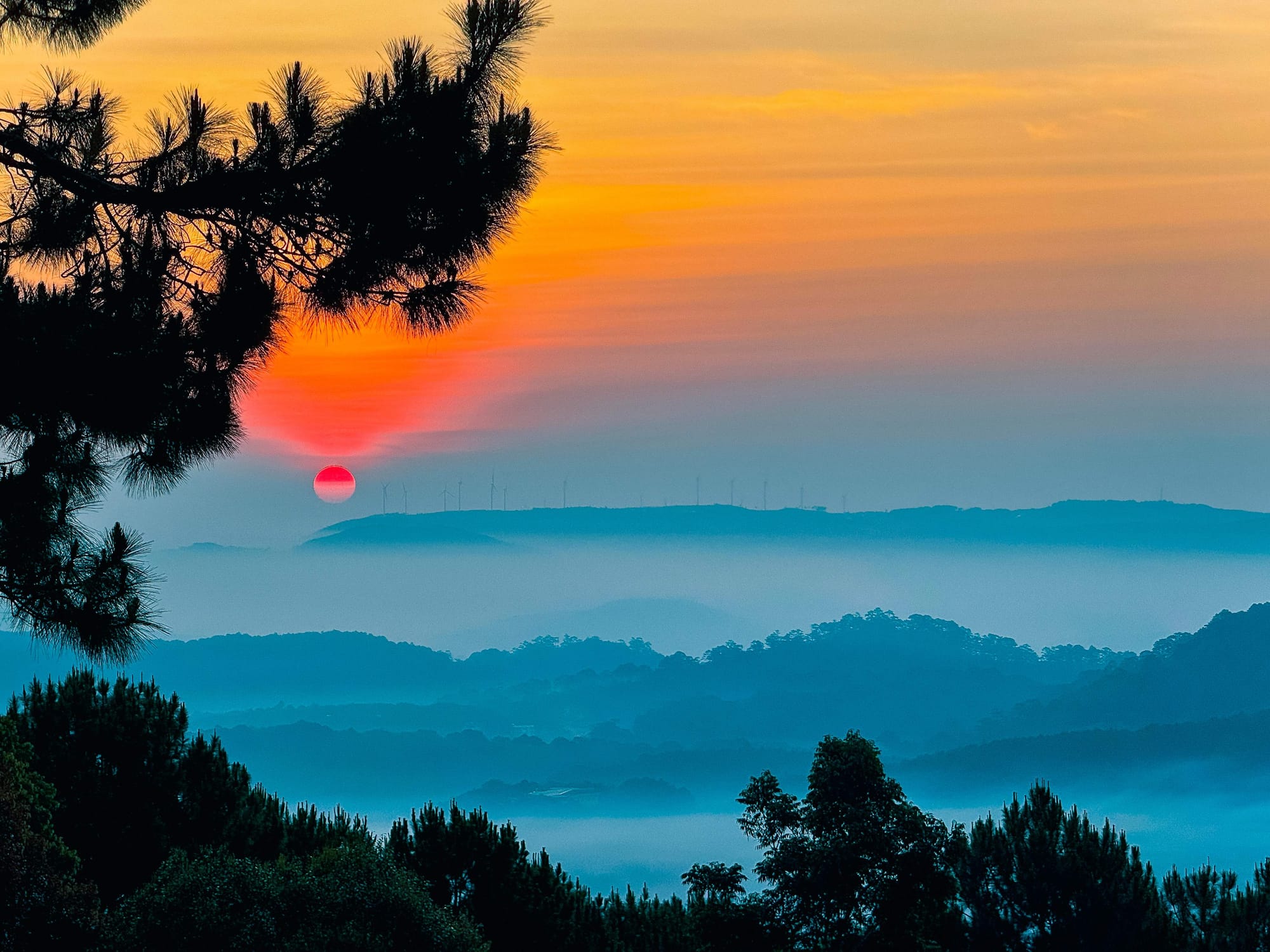
Seated meditation practice at the Da Lat ashramSavasana, the guided relaxation that closes every classSpinal movement is the stated focus of the asana sequenceOutdoor practice by Tuyen Lam LakePhilosophy class on the teacher training courseEvening gathering for chanting and study
For new students
Beginner questions about yoga
No. Sivananda classes are taught with variations for every posture in the sequence, and those variations are the expected form for a new student. Beginners' classes assume no previous experience.
Where to practise yoga in Vietnam
Classes and courses are held at four locations. Open classes at the city centres follow the ninety-minute structure described above; residential programmes at the ashram include the diet, the breathing practices and the evening gatherings alongside the daily classes.
We are happy to answer questions about our programs, retreats, and teacher training courses. Click the Contact Us button below to get in touch, or call us at (+84) 263 650 1100.